Saturday, August 29, 2009

climate camp vs newbury

I'm sat here on Blackheath, site of Wat Tyler's rabble-rousing for the Peasants Revolt, among the roused rabble of the Camp For Climate Action, ready for the pedants revolt.

This afternoon I bumped into an old comrade from the Newbury Bypass and we inevitably compared the two events.

The Climate Camp, like Newbury, is composed of a disproportionate number of young adults, especially students. Indeed, yesterday I had a journalist trying to get the old gimmers like me to grumble about it.

Personally, I've no prejudice against being educated, and given the fact that students are the most likely to have the summer free and least likely to be shackled by mortgage and family commitments, it's not surprising they are here in force. The protests against the Vietnam War and in Tianenmen Square were led by students. I don't think that invalidated them in the least.

But anyway, this young demographic have no memory of the older struggles, and many talk of Newbury in the way we old 'uns speak of Paris 68. It's easy to get all rose tinted along with them, but me and Tot Hill veteran Martin just thought about it properly. There is nothing we can remember about Newbury that Climate Camp doesn't blow out of the frigging water.

There are complaints that Climate Camp's politics are diluted, that it's become a liberal lobbying group awash in NGOs and reformist ideas. Yet Newbury was actively supplied by Greenpeace, supported by many Friends of The Earth groups, and both NGOs often felt like they were entitled to speak on behalf of the campaign. There were nimbyists, conservative conservationists, those who just talked of other ways to move the absurd quantity of traffic instead of having any thought-through systemic critique. Climate Camp draws the demarcation much more clearly and speaks for itself a lot louder.

All radical movements we venerate had their woolly end. This doesn't mean we should ignore it, but it does mean that their presence isn't indicative of an all-encompassing woolliness. Check your suffragette, civil rights or anti-nuclear history, they all had it. The Climate Camp remains overtly radical. The first thing you see coming up the hill or going past on the 380 bus is the entrance banner saying Capitalism IS Crisis.


The programme of workshops and discussions shows the position as against the growth economy. The influx of newbies - half the people at the opening plenary hadn't been to a previous Climate Camp - means many have to be walked through the ideas to join it up, but the enthusiasm for that perspective is startling.

Last night I was in a mass meeting of over 500 people talking about economics beyond capitalism, who understand that not only is there no way the climate crisis can be tackled while capitalism is intact but that as well as immediate action we need to be thinking about the broader abstract cultural issues. And not in a stuffy drywank way that thinks economics is something for economists any more than we believe politics is just for politicians.

The Camp has involved itself with those irritant backbench Labour rebel MPs and the LibDems keen on civil rights, but that hasn't necessitated any move to their parliamentary freemarket politics. At Newbury we fought alongside titled tories, fox hunters, all manner of fuckheads who we'd give stick to on any other day of the week.

At Newbury the police totally decided their own agenda. Here, we have them on the back foot, kept off site despite their threats and desires. Newbury had a huge contingent of those who felt that if we only talked to the police as human beings they'd somehow not defend the forces of destruction. Those at Climate Camp who haven't had experience of the police often feel that way too, but it's easy to disabuse them of the notion and, as a site and group, there is no way the Climate Camp would behave like that.

Climate Camp out-media the police, indeed they are as savvy as people can be with the mainstream media, way more sussed and successful than Newbury, normalising radical perspectives in a far more effective way.

There is a total absence of the dippy new-age bullshit that saturated Newbury. People chanting at trees to ensure they couldn't be cut down and that sort of gubbins. Climate Camp may be idealists, but they're realistic and practical ones. My favourite kind.

And they're not just practical in the application of ideology but in the most obvious sense. The ability to equip everyone with the kit needed to allow the real work of talking, thinking, networking and planning to happen is amazing. They tipped a fully working eco-village illegally and secretly into a field in a few hours.

At Newbury we tolerated all manner of brew-crew lairy fuckers. We had no idea how to include them and get them to be a co-operative element of the campaign, nor any idea how to exclude the tiny number of irredeemably disruptive people. Climate Camp stops most of that bother before it even starts, and the Tranquility team sort out much of what does happen, and even then the process is so collectively and democratically understood that often people don't call in the experts but sort it out themselves.

And part of the reason we put up with those munters was the fact that they would dependably be there, and we needed the numbers. The idea of thousands of people coming together, of a movement pulling in hundreds of new people every time a big event happens, was simply unthinkable.

To put them in the middle of the Met's home turf, retain control and get on with the real business of educating, agitating and motivating one another for action - not as a single focus but an ongoing culture of action - would have been an insane joke. The sheer weight of numbers is gobsmacking.

It's never in the bag, all movements make mistakes and all movements need continual vigilance and tweaking if they're not to be co-opted or diluted or burned out. But on those fronts and all the others listed above, Climate Camp is the real deal.

It's not that they're some sort of great guru overachievers pulling it out of a hat. It's the culmination of a lot of lessons learned from sites and campaigns over the last 20 years, and indeed Newbury was part of that experimentation and refinement process. It is clearly on the current front end of all that and its awareness and creativity are immense. It has, as Newbury did, that feeling that this isn't something these people are doing but something they are, that this is a rolling network rather than an event.

Newbury was an amazing campaign, an inspiration to others around the world and a radicalising force for a huge number of people. At the time it felt fractious but righteous, chaotic and dicey but cool as fuck to be in the middle of. Climate Camp is all that and more.

Tuesday, August 25, 2009

climate camp's cross-dressing cops

The police are very much on the backfoot now they're widely believed to be over-reactive, intimidating and violent.

Half of UK adults think that policing of environmental protests is too heavy handed or involves too many officers, according to a YouGov poll of over 2,000 people conducted on behalf of Christian Aid.

Of those surveyed, 18% said they were put off joining protests in future because of their fears about how demonstrations are handled and 33% said that filming protesters is an invasion of privacy.


In response, the police are engaging in - to use a Mandelsonism - an attempt at political cross-dressing. Police say they'll be using 'community style' policing at this week's Climate Camp in London.

Chris Allinson, head of central operations at the Metropolitan Police, said around 500 officers will be needed everyday to police the camp.


Which community gets one officer for every two or three civilians? The only one I can think of is prison.

“Every cop on an event is a cop who is not one the streets policing London,” he added.


Couldn't have put it better myself. Aren't there any incidences of mugging, domestic violence or child abuse in London that might be worthy of their attention?

And even as he talks his cuddly community policing guff, Assistant Commissioner Allison refuses to rule out kettling.

All this comes as the Climate Camp activists suing the police for the G20 reveal that police notebooks admit punching protesters in the face and smacking them with the edges of shields, and in the week where the Home Office said the police could be issued with a new higher-powered taser, the weapon used to threaten sleeping climate camp protesters in April. They're going to have to work harder if they be convincing in their new teddy bear persona.

Why are the Camp having to sue? When there is such clear evidence of assault why are the officers who beat people not disciplined, sacked and publicly prosecuted? Why is the officer who planned and ordered the attacks at the G20 not named and imprisoned?

This closing of ranks is proof that the new touchy-feely stuff is just crass window dressing. If they turn on the charm to the media then people will think it's all OK now, and they can avoid any real reform and get back to intimidation and breaking heads.

So, unconvinced that the police's Twitter account marks any change in principles, Climate Camp responded with an open letter to the police, and for good measure made it into a wry pisstakey infomercial.

Monday, August 24, 2009

mosh or be elsewhere

I just bought tickets for Motorhead at Leeds Academy. The person at the box office said there were 66 left for standing and just over 100 left in the seats.

This means over two hundred people have chosen to buy seats even though there's room in the stalls.

Who the fuck are these people? Excepting those with a relevant disability, anyone who would prefer seated tickets for Motorhead shouldn't be allowed any tickets for Motorhead.

Top of the list for my first decree when I'm president of the world.

Wednesday, August 19, 2009

the great climate swoop

As the Copenhagen talks to create a successor to the Kyoto Protocol loom closer, the imperative for action grows.

On the 17th and 18th October there will be a mass action to shut down a coal-fired power station in England. Which one? That's not decided. It'll be Drax or Ratcliffe and, with the kind of brazen cheek you normally only get from Class War or Plane Stupid, there's an election going on to see which one people want to hit. At a festival recently I saw a stall with voting cards and a proper ballot box.

There are very good reasons to go for Drax in Yorkshire. It's the largest source of CO2 in the UK. Most countries don't emit as much as Drax.

Ratcliffe is far filthier per unit of energy produced, though. It's owned by Eon, a global giant in carbon terms, the company pushing to build Kingsnorth, the UK's first new coal station in a generation. And frankly their bullshit about how their solar panels make them an 'integrated' power station (contributing a fraction of a millionth of their output) is the biggest load of horseshit I've ever heard and they deserve a big slap for that alone, even before anyone starts saying 'clean coal'.


Either way, whilst the small bands of people doing audacious actions are good it's about time there was a mass publicly announced one. There is no more important element in reducing carbon emissions than stopping coal. If you know that there's no way we'll stop coal by hoping for the goodwill of governments and the energy industry, then you know you've got to do something.

So, sign up to the Great Climate Swoop. 17th October. See you there.

Monday, August 17, 2009

news from nowhere

William Morris' 1890 novel News From Nowhere is that thing I have a deep love for - a blunt and blatant rant against a social evil given barely enough fictionalisation to make it something other than straightforward polemic.

In John Waters' Cecil B Demented he has a gang of outlaw film-makers kidnap a Hollywood star to rail against the Hollywood studio system. In Bruce Robinson's follow-up to Withnail & I, How To Get Ahead In Advertising, although the plot concerns a crisis in an advertising exec's life it's really about a broader evil, it's about consumerism.


Morris' conceit in News From Nowhere is to have a nineteenth century man awake in the post-revolutionary twenty-second century.

He doesn't pick on a social evil in the narrow context, but the whole profit-driven, acquisitional, possessive consumer culture. Written a year before Oscar Wilde's magnificent The Soul of Man Under Socialism, it seems very much a companion piece. Big dreaming, deeply compassionate, wildly revolutionary yet profoundly humane.

That it seems so pertinent now could be either depressing (five generations and much of it has gotten worse) or inspiring (a masterpiece dismissed as sentimental claptrap then but is clearly utterly fucking visionary from where we stand now).

This bit hit me right between they eyes. A twenty-second century man explains to his nineteenth century visitor what the problems were back then.

===========

"The labour-saving machines? Yes, they were made to 'save labour' (or, to speak more plainly, the lives of men) on one piece of work in order that it might be expended - I will say wasted - on another, probably useless, piece of work. Friend, all their devices for cheapening labour simply resulted in increasing the burden of labour.

"The appetite of the World-Market grew with what it fed on: the countries within the ring of 'civilisation' (that is, organised misery) were glutted with the abortions of the market, and force and fraud were used unsparingly to 'open up' countries outside that pale.

"This process of 'opening up' is a strange one to those who have read the professions of the men of that period and do not understand their practice; and perhaps shows us at its worst the great vice of the nineteenth century, the use of hypocrisy and cant to evade the responsibility of vicarious ferocity.

"When the civilised World-Market coveted a country not yet in its clutches, some transparent pretext was found - the suppression of a slavery different from and not so cruel as that of commerce; the pushing of a religion no longer believed in by its promoters; the 'rescue' of some desperado or homicidal madman whose misdeeds had got him into trouble amongst the natives of the 'barbarous' country - any stick, in short, which would beat the dog at all.

"Then some bold, unprincipled, ignorant adventurer was found (no difficult task in the days of competition), and he was bribed to 'create a market' by breaking up whatever traditional society there might be in the doomed country, and by destroying whatever leisure or pleasure he found there. He forced wares on the natives which they did not want, and took their natural products in 'exchange,' as this form of robbery was called, and thereby he 'created new wants,' to supply which (that is, to be allowed to live by their new masters) the hapless, helpless people had to sell themselves into the slavery of hopeless toil so that they might have something wherewith to purchase the nullities of 'civilisation'.

"Ah," said the old man, pointing the dealings of to the Museum, "I have read books and papers in there, telling strange stories indeed of civilisation (or organised misery) with 'non-civilisation'; from the time when the British Government deliberately sent blankets infected with small-pox as choice gifts to inconvenient tribes of Red-skins, to the time when Africa was infested by a man named Stanley, who-"

"Excuse me," said I, "but as you know, time presses; and I want to keep our question on the straightest line possible; and I want at once to ask this about these wares made for the World-Market—how about their quality; these people who were so clever about making goods, I suppose they made them well?"

"Quality!" said the old man crustily, for he was rather peevish at being cut short in his story; "how could they possibly attend to such trifles as the quality of the wares they sold? The best of them were of a lowish average, the worst were transparent make-shifts for the things asked for, which nobody would have put up with if they could have got anything else. It was a current jest of the time that the wares were made to sell and not to use; a jest which you, as coming from another planet, may understand, but which our folk could not."

Said I: "What! did they make nothing well?"

"Why, yes," said he, "there was one class of goods which they did make thoroughly well, and that was the class of machines which were used for making things. These were usually quite perfect pieces of workmanship, admirably adapted to the end in view. So that it may be fairly said that the great achievement of the nineteenth century was the making of machines which were wonders of invention, skill, and patience, and which were used for the production of measureless quantities of worthless make-shifts.

In truth, the owners of the machines did not consider anything which they made as wares, but simply as means for the enrichment of themselves. Of course the only admitted test of utility in wares was the finding of buyers for them - wise men or fools, as it might chance."

Wednesday, August 12, 2009

curiously specific

Come with me to Southampton Road in the market town of Ringwood, and ponder as I have.

How exactly did they decide how much to charge an unauthorised motorist for parking their car?

You can almost hear the disagreement in the meeting and the dissatisfied harrumphing at the compromise figure agreed upon.

wheel clamping, release fee £73

Thursday, August 06, 2009

planes, trains and tory numpties

Just because the Euro elections are over doesn't mean you don't get political leaflets through the door. The Conservatives' parliamentary candidate for Leeds North East, Matthew Lobley, has been dishing out some.

Leaflet for Conservative candidate Matthew Lobley

Down there at the bottom we see that

the next Conservative government would invest in a High-Speed Rail link connecting Leeds to London, Birmingham and Manchester...

Matthew commented,' This will be great news for Leeds, reducing travel times and so supporting our Leeds economy and jobs. For too any years we have seen Leeds, the finance capital of the North, miss out to Manchester"


Missing out to Manchester? Would that be the Leeds that's had two-hour train journeys to London for a decade or two while equidistant Manchester only got that upgrade a couple of years ago?

Meanwhile, with no sense of irony or conflict, on the back of the leaflet we get this lament:

the news that BMI has scrapped its flights between Leeds and Heathrow is hugely disappointing to Leeds people.


Firstly, I wonder what proportion of people in Leeds ever used a flight to London. Of this tiny number, what subgroup could describe themselves as 'hugely disappointed' that the service was axed? Would anyone guess it was more than a sliver of a fraction of one percent of the amount needed to qualify as being representative opinions of 'Leeds people'?

The government has just announced a swathe of high-speed rail links with the explicit intention of killing off domestic flights, saying

For reasons of carbon reduction and wider environmental benefits, it is manifestly in the public interest that we systematically replace short-haul aviation with high-speed rail.


But this is seemingly not an issue to Lobley, a man who manages to talk about future energy policy without reference to carbon, and on his website only manages to mention it once, as "global warming", complete with quote marks.

For him, it's just that we need journey times cut. That'll make the train compete with the plane. Except the normal train already does.

Matthew and those hugely disappointed Leeds citizens will be relieved to know that Flybe have picked up the service and fly from Leeds to Gatwick.

Choosing a date and time at random, the 14.05 flight on 9th September from Leeds to London takes an hour and ten minutes. Add the minimum 30 minutes check-in time and it's 1.40. And that's before we recognise that the train terminates right in the city, whereas the flight leaves from outside Leeds and lands a good half an hour's journey away from actual London.

The 14.05 train takes 2 hours 17 minutes. So, there's nothing in it timewise and the train's almost certainly the better option on that front.

Not so with the price, however. The flight costs £24.99 including taxes. The train costs £84.00. What can we do about this incentive to take the high-carbon option?

In January 2007 David Cameron suggested

I think what we need to have is we've got to make sure that air travel more accurately reflects all of the costs. And, if you like, what the Economist would call the externalities, the pollution cost. I think that is important. And I think that would lead to a fairer competition between, between rail and air travel, particularly within the UK.


On 13 September 2007 the Conservatives published their Quality of Life report. The same day, in light of the report's recommendations, it was reported that

David Cameron will finally bite the bullet on green taxes today by backing the imposition of VAT on aviation fuel on domestic flights


Less than two weeks after the 547 page report was published, Cameron had read it and removed his teethmarks from the bullet.

We’ve put forward some different options, we’ve now looked at that and decided the right option, which is to not do VAT on domestic flights, that VAT on domestic flights was not an option.


So, if nothing else, at least Lobley's in line with his party leader, sticking his fingers in his ears and going lalala about aviation emissions.

Sunday, August 02, 2009

organic food isn't a health fad

Last week the Food Standards Agency published a report showing that organic food has no nutritional advantage over crops produced by conventional farming.

It was swiftly criticised for not looking into the negative effects on health of the agrichemicals in non-organic food. It's kind of like saying that as neither of the two people in front of you is patting you on the head they're being identically nice, because we haven't looked down to check if one of them is kicking your shins.

The Soil Association took issue with the report, citing - from the studies used by the report itself - positive nutritional differences for organic food. But they, and the reporting in general, miss the major point. There are other very important reasons to eat organic.

As a nation, we're used to food health scares. In the wake of botulism, salmonella and all the rest we were sold GM crops as a possible threat to the wellbeing of those who eat it. It's certainly something to be looked into, but the indisputable detrimental effects of GM crops are corporate control of the food supply and - what even the pro-GM governments trials proved - the detrimental effect on wildlife.

By the same token, non-organic farming is not just a health issue for those eating it today. When, some time in the next generation or so, we pass the point of peak oil and the price rockets upward forever, we're going to need alternatives. The oil-derived agrichemicals we rely on for today's bumper monoculture harvests are going to become prohibitively expensive. Developing advanced organic methods is a sound investment for keeping our cupboards full in future.

It's not just giving ourselves a headstart of good techniques either, it's also preventing regression. Conventional farming uses vast quantities of artificial nitrate fertilisers. About a third of them are actually consumed as food. The rest enters the nitrogen cycle on the land and water. This run-off is having a major impact on biodiversity.

Organic methods rely on interaction with wildlife, by comparison conventional farming assaults it. Destroying biodiversity today hobbles our ability to use it for organic methods in future.

And by the way, how come farming practices that are only used in some of the world, and even then are only two generations old, are 'conventional' and everything else is, by implication, unconventional?

Do agribusiness folks have a different dictionary to me?

The first time I stood in an organic vineyard I knew it was different. There were flowers growing between the rows of vines, flowers in full bloom. The air was alive with the sound of buzzing insects, insects that lived among the flowers, zooming around the vines searching out the pests that prey on grapes.

I was witnessing nature's system of checks and balances in full operation. The vines themselves turned their leaves to the sun, with a sheen on the leaves I hadn't seen in conventional vineyards. Above all, there was a different atmosphere - of life, of vitality. It was such an exciting moment.

- Hilary Wright, The Great Organic Wine Guide


There is another very major reason to eat organic. A significant amount of those fossil-derived nitrate fertilisers breaks down into nitrous oxide, a greenhouse gas 298 times stronger than CO2. Eating organic means less climate change.

Far from being a selfish health fad, it's about promoting a responsible method of food production for all and tackling the most urgent crisis we face. And it gives us an opportunity to do that with every meal we eat.

Tuesday, July 28, 2009

veneration and defecation

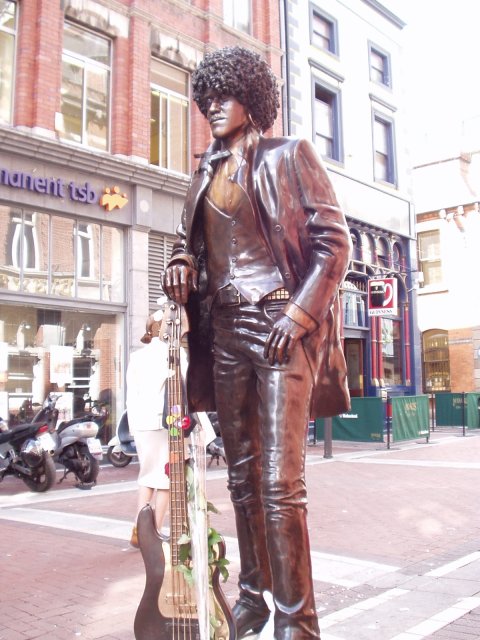
Jim Bliss recently marvelled at what we can learn about a culture from its choice of statues. London, he notes, has a great diversity of figures,

But mostly it’s soldiers. Lots and lots of soldiers. Men who excelled at killing people from beyond the city walls, or who were cruelly killed by people from beyond the city walls. And we invite them back to stand silently among us. One of them stands atop a pedestal so high, you can’t really see him clearly.


He explains that Dublin, by contrast, has revolutionaries and perhaps the zenith of modern statue making, Phil Lynott.

But there is a backhandedness in statues that, whilst not making me enjoy being surrounded by giant models of killers, does give a bit of subversive balancing.

George Melly was once asked where he'd like a statue of him to be erected and he said he hoped there wouldn't be one. As those who do get them are inevitably and unendingly shat on in effigy by pigeons, a visitor from another planet might think they were the ancestors we most revile.

As Malcolm Reynolds said

It's my estimation that every man who ever got a statue made of him was one kind of sonofabitch or another.


But there's a hierarchy element too. George Orwell declared

What I like best is the careful grading by which the honours are always dished out in direct proportion to the amount of mischief done – baronies for Big Business, baronetcies for fashionable surgeons, knighthoods for tame professors.


By the same token, it's not only Reynolds' point that the bigger a fucker someone was the more likely they are to have a statue of them, but also that we'll make the statues on a greater scale and in greater quantity.

The plethora of grand guano targets of Queen Victoria and the Duke of Wellington mean they're probably the most shat on people in British history.

There was a great hoo-hah about disrespect when a Mayday demo gave the Churchill statue a grass mohican. Yet this sort of thing is standard treatment for statues. Again, that martian might think that all statues were a form of bonfire Guy, seeing the founder of the NHS Aneurin Bevan with a traffic cone on his head. Or the one in Leeds where, in addition to his perenially repainted boots, the puffed up pomposity of the Duke of Wellington has just been augmented with a Homer Simpson mask.


Wellington statue with Homer Simpson mask

It's as if Two Minutes Hate would be too genuinely angry, these figures are more dismissed than that, they get a Few Seconds Arsing About.

Wellington's statue is one of four on Woodhouse Moor, and collectively they spell out another form of disrespect. Wellington, Victoria and Robert Peel originally stood in Victoria Square outside the town hall, but were moved in 1937 to make way for a car park.

The fourth is Victorian industrialist and mayor of Leeds Henry Marsden whose statue gives the name to the area called Monument Moor. It was called Swing Moor prior to Marsden's arrival in 1952, when he was moved there from a city centre road junction where he was a hindrance to the increasing amount of motor traffic.

As I recently said about these statues on my Hyde Park History blog,

we used to venerate these folks in the city centre, but we've sidelined them to a peripheral park in order to make way for increased traffic. Collectively, then, they stand as a monument to the motor car.

Their moving is not a sign that we've stopped venerating things, just a physical acknowledgement of the change in what we worship.

Friday, July 24, 2009

fuck you liberal democrats

Having recently set out what I think poetry shouldn't do, here's an instance of what it can be well used for.

Poetry should come from the heart and speak the truth. Or, as a real poet said,

Poetry is just the evidence of life. If your life is burning well, poetry is just the ash.
- Leonard Cohen


The Speaker's Forum is a phenomenally interesting space at Glastonbury Festival. You get a broad range of political and countercultural figures there, not just declaiming to the adoring masses but having involved Q&A sessions. You can find someone good and get them to expand on an idea that a mass-media interview would never allow, or you can cross-examine on an issue that they're dubious on. This year saw Ben Goldacre, Tony Benn and Glasto godfather Michael Eavis.

I was in a team who did performance poetry there, and we were interestingly scheduled. On the Saturday we were before Mark Thomas, which was cool, and appropriate in a flattering way. But on the Sunday we were on between Daily Mail astrologer Jonathan Cainer and Liberal Democrat leader Nick Clegg.

It was obvious that Clegg would be doing a touchy-feely greenwash performance, and so I hastily composed a poem to do at the end of our set to undermine his bullshit.

There's already been a back-and-forth in the comments of an earlier post about the confrontational attitude of the poem. It comes across as angry, and that's for a very simple reason. I am angry. The LibDems are neo-colonialists who masquerade as responsible green sustainability folk.

Wakey wakey time. Rampant freemarket capitalism is not neatly compatible with tackling social injustice and the environmental crises caused by overconsumption. It creates and exacerbates them.

Those, like the LibDems, who pretend we can have perpetual economic growth whilst dealing with those fundamental problems are - in the phrase used in the performance's preamble - the agents and engines of destruction.

And whilst the poem is certainly angry and aggressive, it's not puerile. I think I did quite well in avoiding rhyming Liberal Democrats with twats.

There were a couple of people filming it (both of whom had batteries fail) but the various clips have been spliced together to get a complete version.


For completeness' (and googlability's) sake, here's the text of it too. Performance poetry rarely reads well on the page, the rhymes aren't at regular intervals nor does it stick to a single meter de-de de-de de-dumming along.

The wording's been tweaked a little (the original was done written in hurry with all the distraction and brain-inhibiting factors associated with proper festival enjoyment).

FUCK YOU LIBERAL DEMOCRATS

Everything in this is absolutely true.

I learned about environmental action fast
I was given a masterclass
Up the trees that were in the path
Of the infamous Newbury bypass
It was an issue so clear-cut
A plan that was so far gone
That before it was built the Tories who ordered it
Admitted that they were wrong.
But there were two voices in favour then
Unrepentant to this day, in fact;
Newbury's council and MP David Rendel
Both of them: Liberal Democrats.

LibDem councils were at it again in Kingston on Thames
Taking on tree protesters there to defend
Mature poplar trees the LibDems said that
Spoiled the view for new luxury flats.
No prizes for guessing who won, protesters or interests vested.
The copse was cut down, the monies moved in and the protesters all got arrested.

When it came to GM then the LibDems
Volunteered themselves as biotech's friend.
The people wanted modified crops
To be banned, and the trials to stop.
In Westminster, where they had no power
The LibDems said we should go no further
But at the the same time in Scotland, in government,
They voted unanimously in favour.

With Manchester airport's second runway
In Stockport, where they held no sway,
The LibDems said such a monstrous plan should be fought
But in Manchester council, who own the airport,
The LibDems gave it wholehearted support.

I'm from central Leeds and the other year
The LibDem council of our city
Came up with a plan to spend 170 grand
To make my local park look pretty;
Turn it into car parking spaces.
Well, you should've seen our faces.
Not even their rigged 'consultation'
Was enough to allay our consternation.
The LibDems bullshat and backpedalled
And tried to win a spin gold medal
Saying it could have shrubs and nice coloured tarmac
But that risible attempt to fudge it
Isn't the punchline - no, that's the fact that
The 170K was the 'Parks Renaissance' budget.

The Green Party quit the city government
Not for the park but an environmental crime even greater
The LibDems plan to choke their voters
With a PFI waste incinerator.

They say now they were always against the war
But those who remember 2003 know the score
They were proudly "not the all-out anti-war party" then
They just wanted approval for war from the UN.
Not against the war, just after one more vote,
And the reasons for the war?
Well they said - and I quote -
It was "ridiculous" to say it was all about oil
No, Saddam's a bad man with WMDs on his soil.

When the troops went in the LibDems said
We shouldn't object to this war crime's colossal violence
Their leader said, I quote again,
"Now is the time for silence".
Well if you feel shamed and stained
By the threat of mass murder in your name
You've got to shout louder when troops go over the border
So fuck you, Liberal Democrats, and your collaborators gagging order.

They're the same when it comes to climate change
Whatever they try to spin
I though Chris Huhne was just a buffoon
Their environmental spokesman
But then I saw him dodge and weave and lie
And I knew he was really a man on a mission
To hand governance to corporations
Like every other mainstream politician.

He said he's against carbon rationing
Cos it'd take too long to implement
As if it's quicker to wait for elections
That'll bring us LibDem government.

The LibDems, Huhne said, won't stop airport expansion
No matter what devastation it may bring
"There's a contradiction in you wanting to relocalise life
Yet have a central ban on things".
So you see, it's not stupidity
But something much more sinister
"I don't want to see things run from some
office in Whitehall," says the man who wants to be a Minister.

The LibDems policy paper called "Setting Business Free"
Says they "start with a bias in favour of market solutions". Why's that? Me,
I start with a bias for effective solutions
And ones that are sustainable and fair,
And if the markets have taught us anything
It's that we won't find those values there.

If there's ever any conflict
Between anything and profit
Then the holy market doctrine doth decree
Profit wins every time
And the losers are
Social justice and sustainability.
When they say they want to "cut red tape" they mean the regulation
That stands between corporations and employee exploitation,
The accountability of directors, and environmental devastation.

So if profit isn't primary to you join me
In saying this one thing, that's
'Shove your "Manifesto For Business" up your arse,
Liberal Democrats'.

Opposition politicians
Always promise everything to everyone
We saw it from Labour before 97
Now we see it from Cameron.
Being in opposition most places most times
Makes it easy for LibDems to claim compassionate intent
But look at where they've been in power
And you'll see that they're no different.

So you freemarket fucks, you'll be judged
Not by your spin but by your acts,
We know who you are, we've seen what you do,
And we know that yellow isn't green, it's blue
Fuck you from here to Timbuktu,
Liberal Democrats.